Showing posts with label Gay Crime. Show all posts

Gay Banker's killer will walk free-Maybe


photo
Family photo
Paul Broussard, 27, was killed in Montrose in 1991.


Sometime in October, Jon Buice is set to walk out of a West Texas prison a free man, clear of his debt to the state for killing gay Houston banker Paul Broussard in 1991.
But a growing contingent of local elected officials is working behind the scenes to make sure Buice doesn't taste freedom quite yet.
Buice (pronounced "Bice") is serving 45 years in prison for his part in Broussard's murder, which stunned this city two decades ago. Commissioners in the Amarillo office of the Texas Board of Pardons and Paroles voted 2-0 on July 1 to approve Buice's parole.
Harris County District Attorney Pat Lykos recently wrote a letter to the board, graphically recounting how 10 Woodlands-area "co-conspirators" drove to Montrose to bully homosexuals, targeting Broussard, then 27, and two friends.
"The defendants swarmed out of their vehicles, chased Paul down a dead-end street, surrounded him and they attacked — beating the defenseless Paul Broussard with a nail-studded two-by-four, kicking him in the face, chest and groin with steel-toed boots, crushing his testicles, hitting him with their fists and, finally, Jon Christopher Buice stabbed him to death," the letter stated.
Broussard died July 4, 1991, at St. Joseph's Hospital, after emergency surgery.
Buice, now 37, pleaded guilty to murder and went to prison in December 1992. The other nine are on parole.
State Sen. John Whitmire, D-Houston, chairman of the Senate Committee on Criminal Justice, wrote a letter July 7 to the parole board, expressing concern that the vote for Buice's release involved only two parole commissioners and no governor-appointed board member.
In an interview, Whitmire also said the parole process is inconsistent.
"It's amazing to me the number of nonviolent, young offenders they routinely deny parole, and then you see a murderer serving less than half his sentence get paroled," he said.

'Heinous nature' of crime

Whitmire said it's unusual for him to write a letter to the parole board.
"I think if you do it too often, they think it's your routine," he said. "It's not my routine. I don't get people in prison or out of prison."
State Sen. Rodney Ellis and state Reps. Jessica Farrar and Garnet Coleman, all Houston Democrats, also sent the board letters.
Coleman said part of his reason for writing was this crime's "heinous nature."
The parole board handles most parole reviews regionally, with offices in six locations. Each office has one board member appointed by the governor and two parole commissioners named by the board.
The Amarillo panel handles parole requests from 27 West Texas prisons, including the Wallace Unit in Colorado City, where Buice was transferred last year after he developed a relationship with a female chaplain in Huntsville. There was no evidence the relationship was sexual, but officials deemed it "inappropriate."
Buice was approved for parole in October under conditions of "maximum supervision," electronic monitoring and substance-abuse treatment.
Reasons for his pending release included his age of 17 at the time of the offense and the college degrees he has earned in prison.
Rissie Owens, the board chairwoman based in Huntsville, said the Texas Department of Criminal Justice Victim Services Division will process all protest information concerning Buice's pending parole and will send it to the Amarillo panel.
The panel can review the information and decide whether to modify the previous vote, Owens said.

Friend defends inmate

Ray Hill, a long-time gay-rights activist and former prison inmate who has befriended Buice and is championing his release, said he takes issue with the often-repeated claim that the attackers used nail-studded boards and steel-toed boots. Hill said he was at the crime scene soon after it happened and neither saw nor heard evidence of such weapons.
Broussard's autopsy noted a puncture wound with a surrounding abrasion on his back, indicating he was hit with a board with nails, said retired Judge Mike Anderson, the prosecutor at Buice's trial.
As for the boots some of the perpetrators wore, Anderson said he wasn't sure they had steel toes but thought they could still inflict injury.
"It was so bad, nobody had to exaggerate," Anderson said. "We had a good-faith argument in saying they were attacked with boards with nails. There was some construction around there, and we thought this was a weapon of opportunity."

Group opposes release

Noel Freeman, president of the Houston Gay and Lesbian Political Caucus, said the group voted several months ago to oppose Buice's release and has encouraged its 800 members and 5,100 email recipients to write to the parole board.
Nancy Rodriguez, Broussard's mother, said she appreciates the support.
"I spend a lot of time on the phone, calling everyone I can think of, asking them to write letters to withdraw the vote," said Rodriguez, who lives in Georgia, where Broussard grew up and was a high school honor student before earning a degree at Texas A&M University.
Andy Kahan, crime-victim advocate for the city of Houston for 19 years, said he and Rodriguez are planning to give state officials new information in the next month that they hope will block Buice's parole.
Kahan declined to give details.


 

Arrest Made in gay immigrant found burned, left in park dumpster


San Francisco police have made an arrest in connection with the murder of a gay immigrant whose body was discovered last month burned beyond recognition.
Freddy Roberto Canul-Arguello
David M. Diaz, 22, is being held on homicide and arson charges in the June 10 slaying of Freddy Roberto Canul-Arguello.
Canul-Arguello’s body was discovered by San Francisco firefighters responding to a reported brush fire incident in Buena Vista Park in the city’s famed Haight district — they found his partially burned body in an nearby dumpster.
Police said they believe Canul-Arguello had been killed prior to his body being burned.
Canul-Arguello’s friends and his grieving family are wondering if Freddy’s openness about his sexuality may have triggered the killing.
One friend, Javier Perez, 29, who described himself as Freddy’s best friend, said that Freddy had two passions, cooking which was his profession and dancing in drag.
Canul-Arguello had moved to San Francisco with his brother Ivan four years ago from their native Mexico.

'Gay Panic' Defense in Oxnard slaying, Being Fought by DA

 
"We can't restrict the free speech rights of the defense and the ability of a defendant to mount their defense," said Sally Lieber, the former assemblywoman who wrote the Gwen Araujo Justice for Victims Act. "But the judge should instruct juries that a person's gender or sexual ID is not an invitation to assault or murder."
The trial of an Oxnard teenager accused of gunning down a gay classmate he thought was flirting with him marks the first test of a state law allowing judges to admonish jurors that a victim's sexual orientation should not influence deliberations.


Attorneys for Brandon McInerney argue that their client, who was 14 when he gunned down Larry King in an Oxnard junior high school computer lab, was so humiliated by King's flirtation that it provoked him to kill his classmate. Gay rights advocates say the argument is a classic "gay panic" defense.


The panic defense became a flashpoint following the 2002 slaying of Gwen Araujo, a Bay Area transgender teen who was beaten and strangled by three men. Defense attorneys for the suspects argued that their clients panicked after learning Araujo was a biological male and won a mistrial.


When the suspects escaped first-degree murder convictions, legislators responded by passing a law designed to blunt the use of panic defenses.


Similar panic strategies have been used in more than 45 cases nationwide, according to Equality California, a San Francisco group that sponsored the 2006 Gwen Araujo law and advocates civil rights for gay and transgender people. Prosecutors sometimes agree to reduced charges because of the difficulty of facing a "gay panic" defense in certain parts of the country, especially in the Bible Belt, the group said.


In the McInerney case, the defense doesn't deny that their client is the one who pulled the trigger, but they say the teen was pushed to an "emotional breaking point" after the flamboyant King made him the focus of unwanted flirtatious attention at school.


Ventura County Senior Deputy Dist. Atty. Maeve Fox this week said she would invoke the Araujo law when the case is sent to the jury, asking that the panel of nine women and three men be instructed not to let biases toward the victim's sexual identity influence their deliberations.


Legislators and advocacy groups that pushed hard to see the law passed say they are gratified to see the jury instruction invoked. 

McInerney's trial on a first-degree murder charge is in its third week in a Chatsworth courtroom. Multiple students have testified that King, who had recently been placed in foster care, began showing up at school in feminine accessories and makeup.

Rumors swirled about King blowing kisses at McInerney and asking him to be his valentine. On the day before the Feb. 12, 2008, shooting, King loudly said "Love you, baby!" to McInerney as they passed in a corridor.

McInerney started to make a move toward King, but his friends held him back, students and a teacher testified. He told a friend he was going to bring a gun to school the next day, and he did. During a first-period English class, McInerney took out a Saturday night special and shot King twice in the back of the head, witnesses testified.

Fox, the prosecutor, has told jurors that McInerney was motivated not only by his dislike of King but by a budding white supremacy ideology that holds homosexuality as an abomination. He is also charged with a hate crime.

Defense attorney Scott Wippert in opening statements said he would show that McInerney was a good kid who came from a broken, violent home filled with firearms and was provoked into the attack by King's repeated sexual advances.

Gay panic defenses are used because they often work, said Cynthia Lee, a law professor who wrote a 2008 UC Berkeley Law School Review article on the topic. In February 2006, a Kentucky man successfully won a lighter sentence after using a gay panic argument, according to a report by Equality California.

In the same year, a Fresno man who stabbed a transgender person 20 times agreed and was permitted to plead guilty to a reduced crime that brought a four-year sentence. The Fresno district attorney reportedly cited the difficulty of overcoming a panic strategy as a reason for offering the plea deal.

"There is no question that when murder defendants argue gay panic, they seek to tap into deep-seated biases against and stereotypes about gay men as deviant sexual predators who pose a threat to innocent young heterosexual males," Lee wrote in the law review article.

Despite the "corrosive" effect of gay panic defenses, Lee argues that there should be no attempt to outlaw them. States should instead institute jury instructions such as California's that remind jurors that a victim's sexual orientation is not a credible criminal defense.

"Suppression of gay panic claims, like suppression of bad speech, will not eliminate the underlying stereotypes and assumptions that make such claims persuasive," Lee wrote. "Open discussion and debate is a better way to combat those assumptions."

McInerney's lawyers are expected to present their defense later this week. The case could be sent to the jury within the next two weeks, attorneys said.

catherine.saillant@latimes.com


GOProud Head Attacked by Young Guy Yelling The "F" Word

By Lou Chibbaro Jr.


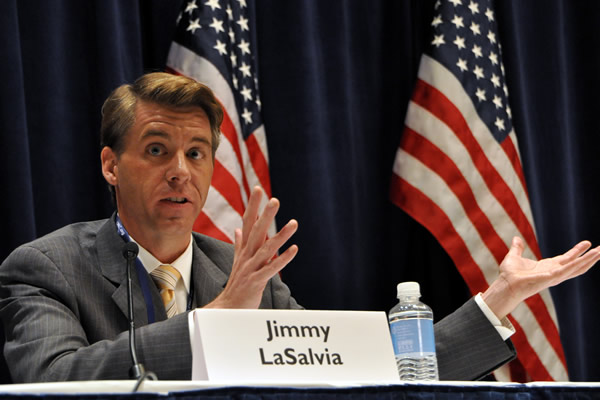
GOProud executive director Jimmy LaSalvia (Washington Blade file photo by Michael Key)
The head of the conservative gay Republican group GOProud was attacked on a secluded street behind Union Station while riding home from work on his bicycle on July 15 by a male teenager who called him a “faggot.”
Jimmy LaSalvia, GOProud’s executive director, said the unidentified youth punched him in the chest about 8:30 p.m. as he rode past the youth and six or seven other male teenagers who were with the person that struck him on 2nd Street, N.E. just north of L Street.
“I was on my bike when I approached them,” LaSalvia told the Blade in an email. “Just as I got up to them, the assailant lunged off the sidewalk toward me on the street and delivered a punch across my chest. The momentum of my bicycling driving me into his fist and arm caused a shocking pain like I’ve never felt before,” he said.
“Just as I began to realize what was happening, I heard it. The words are still ringing in my ears as I write this today – ‘F____ faggot!’ LaSalvia said in his email. “It was clear to me in that moment that my sexual orientation had motivated this attack.”
LaSalvia said that after barely catching himself from falling to the ground, he reached into his backpack for his cell phone, with the thought of calling the police. That action prompted one of the teenagers accompanying the attacker to say, “Does he have a gun?” LaSalvia told the Blade.
The attacker and a few of the others with him “puffed up their chests and were clearly ready to continue the attack,” he said. But seconds later, the group fled the scene after he kept his hand inside his backpack, “allowing them to wonder if I was reaching for a gun.”
He said he then rode home and called the police non-emergency number. A receptionist taking the call instructed him to call 911, saying an officer would come to his house to take a report. But LaSalvia said he didn’t feel it necessary to take up police time for what was no longer an emergency. He said he chose instead to wait until morning to file a police report.
According to LaSalvia, on Saturday morning, July 16, he went to the headquarters office of the police Gay & Lesbian Liaison Unit, which is located in the Sun Trust Bank building on Dupont Circle. Upon his arrival, no one answered the door bell, said LaSalvia, even though he noticed people were inside the office. He said a sign on the door advised visitors to call the GLLU’s pager number, which he did, he said. However, as of Monday morning, no one from the GLLU returned his message.

Gay 'Cowboy' Killed Because He Was Gay

Jason Baron Huggins was murdered in San Diego, Calif.
  •  
Jason "Cowboy" Huggins will always be remembered for his charismatic personality, giving spirit and love for people.
The 31-year-old San Diego resident who grew up in Clarksville was beaten to death with a rock on June 22. He died July 6 at Scripps Mercy Hospital in San Diego, according to a close friend and family members who still live in Clarksville.
San Diego police arrested Joshua Larson, 37, in the killing.
Huggins was openly gay, and the gay community in San Diego has rallied around the incident even though police have not classified Huggins' death as a hate crime. Authorities suspect Huggins and Larson knew each other, said Justin Newman, a close friend of Huggins.
Huggins, who graduated from Clarksville High School, lived in Clarksville with his grandparents and his aunt and uncle, Jennifer and Mark Sanders.
"I hadn't spoken to him until four or five months ago," Jennifer Sanders said. "He called me at midnight. He sounded very good and happy. He was enrolled in school for computer classes. I was excited and happy to hear from him and happy that he was happy.
"Then we got that call on June 22," Jennifer Sanders continued. "The next day we flew out there. The hospital told us he was on life support and was severely brain damaged. They needed permission to take him off life support."
Jennifer Sanders said Huggins died eight days after he was taken off life support.
"I was at the hospital quite a bit," Newman said. "It was heartbreaking. Jason was the type who wouldn't hurt a fly."
Huggins will be remembered as someone who was always himself and cared deeply about other people.
"He was the person that, even though in the last six months he was homeless, he'd still give someone the shirt off his back," Newman said. "He'd go out of his way to help people. He was one of the good ol' boys, one of the last few in the gay community who was genuine and cared about everybody no matter what they were going through. He was always nice; it didn't matter. He cared about and loved everyone."any knew him for his western attire and affectionately called him "Cowboy.""You would never see him without his cowboy hat, a huge belt buckle and cowboy boots," Newman said. "It was his trademark.
"Huggins was also known for his sense of humor."He had one of those infectious personalities," Newman said. "He always made sure he was cracking jokes to make people laugh. Everyone loved him so much. It didn't' matter how bad his life was toward the end, he was still making people laugh. That's why he was loved so much."A funeral for Huggins was held in San Diego, and many of his friends were there.
http://www.theleafchronicle.com

Related Posts Plugin for WordPress, Blogger...